Saturday, March 25, 2006

Knowing vs.merely musing

What has theology ever said that is of the smallest use to anybody? When has theology ever said anything that is demonstrably true and is not obvious? ... If all the achievements of theologians were wiped out tomorrow, would anyone notice the smallest difference? ... The achievements of theologians don't do anything, don't affect anything, don't mean anything. What makes anyone think that "theology" is a subject at all?

--Richard Dawkins

Vis-a-vis factual claims and explanations the crucial question to ask is, How do you know that it's true?

The world's religions claim a lot of things, a good number of them contradicting one another. For example, Buddhism tells us that reincarnation is a fact. Other religions say otherwise and have their own afterlife scenarios. Who among them, if any, is correct? How do believers know that their claim is factually true?

While scientists regularly propose various explanations for a certain phenomenon not yet understood, explanations that not infrequently are contradictory and therefore cannot all be true, the very nature of science is that it is interested in finding out which one among them (if any) is the correct one. Or more precisely scientists are interested in which explanation best explains the data, which one is better in explaining a host of other phenomena (has a greater scope), and which one is better in predicting new phenomena.

Because of its insistence on investigating claims and testing explanations science progresses. It is a reliable way of actually knowing the world. Supernaturalism in contrast has nothing remotely resembling the rigorous epistemology and methodology of science. None whatsoever. It has no means of testing its claims and its claims are not testable. It cannot reliably know that its claims and explanations are true. This is the reason why supernatural beliefs multiply in number. Thus we see divergence in supernaturalism, while there is all the time a convergence in science. The number of competing/contradictory supernatural beliefs increase over time because 1. supernatural explanations/claims/beliefs can be as fantastical, insane, and ludicrous as one wants them to be, and 2. there is no way of finding out which one, if any, is actually true. Supernatural beliefs die only when no adherents are left to believe in them or when they fall out of fashion. The number of candidate scientific explanations, on the other hand, decrease over time, because science is merciless in ruling out patently incorrect ones using methods that have proven their mettle.

Science is predicated on critical thinking and testing its explanations. It is a self-correcting enterprise whose objective is to understand the world as best as possible, to know reality as intimately as possible. Supernaturalism meanwhile must condemn critical thinking, unless it wishes to end its existence, vacuous as it is.

Thursday, March 23, 2006

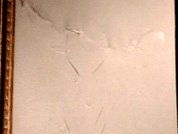
Ah! Finally something nuttier than just pareidolia

It's a simulacrum that's said to cause miraculous healings.

[The Triumph Learning and Worship Center for Life in Alabama] was flooded by Hurricane Katrina; causing some drywall in the building to buckle into an image that church members believe is an image of Jesus on the cross.

The church hung a picture frame up around the mark. People line up every day to touch it, and several people claim they've been healed.

"Many have been healed," said Pastor Ella Roberts. "One young man that belonged here was scheduled to go on dialysis. "The next week, he laid his hand there on the wall on the image, went to the doctor and they said they can't see where, why, how."

Church members say miracles occur when you touch the wall. "From touching that, my eyesight began to clear up completely," said Benita Bogan.

Got bad news for these deluded ones. That's no male on their wall. That's obviously a woman. How could they have missed those breasts! Some virgin they're acquainted with perhaps?

(via Pharyngula)

How not to use a hammer in Bangkok

Smashing idols may be hazardous to your karma:

Worshippers at a famous shrine in an upmarket shopping district of Bangkok beat a 27-year-old man to death yesterday after he destroyed a statue of a Hindu deity with a hammer.

Thanakorn Pakdeepol, who police said had a history of mental illness, was killed by worshippers after he broke into the Erawan shrine and used a hammer to shatter a four-headed statue of Brahma.

The shrine, covered in gilt, is popular with tourists and with Thais, with thousands visiting every day to seek favours and good fortune.

I'm wondering whether Pakdeepol was snuffed out in pretty much the same way he killed the statue because of the desecration or because he dealt a mighty blow to the community's tourism industry.

Dedication to reality at all costs

Psychiatrist M Scott Peck in his various visits to psychiatric wards tells us that when he would interact with the inmates they tended to behave in a way that sent the message, Don't bother me; don't disturb my delusions. They were comfortable with and wanted to continue living in irreality. And that Peck argues is hardly a good thing since he defines mental health as the "dedication to reality at all costs." Delusions obviously and precisely lead us astray and away from reality.

Well, I see this delusionary attitude operative as well in those infected with the (mind) virus of faith, those with supernaturalistic delusions. In order to protect their vacuous beliefs supernaturalists erect various barriers to render their claims more or less immune. They may say for instance that their deity should not be tested/investigated, that their deity demands complete belief and frowns upon doubt, that should their faith be as tiny as an amoeba they could propel the planet Jupiter to another galaxy. But of course those too are claims which necessarily elicit the question, How do they know those are true?

Given that the supernatural is defined as phenomena lying outside the natural realm and has characteristics, forces, mechanisms, processes, etc. that are totally non-natural then it is probably, in principle, not possible to have any test whatsoever that can confirm the reality of the supernatural. If in principle there is no suite of tests that can ever confirm the existence of the supernatural, then that's a death warrant to the belief of supernaturalists. That would mean that they do not know and can never know whether deities and supernatural events are factually true.

Needless to say, because they cannot even know that this very fundamental claim is true--that the supernatural exists--all the subsequent and second order claims thereafter (eg. Allah commanded this, Satan did that, Yahweh made so and so and ordered such and such, winged cherubims relayed voice mail to Mr and Mrs. Clueless, etc.) cannot be known to be true.

And what about the problem of contradictions between the claims of supernaturalists of different religions? The god of one religion is different from the god of other religions. How does Christianity for instance know that its deity is the true one instead of the deities of Hinduism? That its cosmology is the correct one? It certainly can't be based on mere belief. There must be hard evidence at hand in order for one brand of supernaturalism to claim that theirs is factual and true and others wrong.

Supernatural claims have totally nothing going for them. Saying that the problems facing supernaturalists is enormous is an understatment.

To someone who wishes to dedicate himself to reality at all costs, fantastical claims such as the supernatural is certainly among those that must be subjected to unrelentingly rigorous skepticism, investigation, and critique. Since it has not passed muster (and it looks bleaker as we become ever more scientifically and intellectually savvy) then it must be summarily dismissed. Supernatural claims and beliefs are neither necessary for understanding the world or for living our lives nor are they borne out by careful systematic study of the universe.

Believing on faith alone and disbelieving despite a deluge of evidence

There are all sorts of delusions. Creationism (including the latest strain--Intelligent Design) surely must be one of most crazy.

Here are a couple of comments offered by university department heads during a recent survey conducted by Robert Camp on the much bandied, but actually chimeric, "controversy."

The entire biological sciences field from biochemistry to ecology is predicated on the fact of evolution. In 100 years of intensive research no facts inconsistent with evolutionary theory have ever been found. On the contrary, as we have obtained more and more detailed information, especially at the molecular and genomic levels, both the fact that evolution has occurred, creating the species currently existing on earth (including man), and the various mechanisms by which this occurs have become more and more clear. The question is not whether evolution has occurred, but which mechanisms have been most important. There is no need to invoke the supernatural or any higher power to explain life on earth. There is no controversy whatsoever among the many thousands of scientists in the field about the fact of evolution.

--Tom Blumenthal


The faculty in my department variously regard the [Intelligent Design] crowd as insane, ignorant, dangerous, or the butt of jokes. Among our group, ID is considered a not-so-subtle cover for Christian fundamentalist creationism. There are ongoing controversies within the field of evolutionary biology, as in ALL intellectually vibrant scientific disciplines. However, there is no controversy among our faculty about the broad ideas of modern evolutionary biology; that evolution has occurred through processes of natural selection, isolation with genetic drift, and sexual selection. In life sciences, evolution has the same status as a "theory" as the idea that genetic information is encoded by nucleic acids, or that cells are bounded by membranes. That is to say, the evidence is so strong and comes from so many directions, that to deny these fundamental concepts is, in the Year of Our Lord 2006, to be delusional.

--Stuart Dryer

To believe or not to believe--that indeed is the question

When claim/explanation X is fantastical (extraordinary), when there are other claims or competing explanations that contradict X, and when there is no good evidence to support X, then obviously it is insane to believe that X is true and live our lives and perceive reality accordingly. The rational reaction is skepticism and suspension of belief. And because the claim is extraordinary--not a mundane one--the evidential support necessary before we begin believing must proportionally be extraordinary in strength and quality (e.g., we demand much more and much better evidence when someone claims to have $10 million in cash than when he claims to have $10,000.).

An example:

Mike claims that the Malarkians visited the earth 4 billion years ago and seeded the planet with DNA to get life going on our planet. Like a Johnny Appleseed the Malarkians are a race of beings who go around the universe sprinkling DNA on planets they know are fertile enough to support and beget life. But that is how far they go. They don't stay around to tend the garden so to speak. They let life fend for itself.

Bob, meanwhile, claims that it was the Bunkos who had brought life to earth. They accomplished this by shipping in the simplest forms of life first, then on succeeding voyages they ferried in more and more complex creatures, culminating in the shipment of the species of the genus we call Homo. (Bob claims that stories of UFOs and aliens in modern times could mean Bunkos have returned yet again.)

Dan, on the other hand, adamantly maintains that it was the Dorkians who had created life on earth. Dorkians have unimaginable telekinetic powers and were able to create and assemble the various species by thought alone without ever leaving their home planet far away in another galaxy.

Which genesis story should we believe in then? In order to find out let's peruse them: Neither Mike, Bob, Dan nor anyone else has any evidence for the existence of Malarkians, Bunkos, or Dorkians. And for that matter, neither is there evidence for space analogues of Noah's ark and the phenomenon of telekinesis). Furthermore, the above claims are contradictory--these claims/hypotheses can't all be true simultaneously. Finally, they all postulate and allude to novel entities--Malarkians, Bunkos, Dorkians. This makes them unparsimonious compared to, for example, abiogenesis hypotheses (that given the conditions on earth billions of years ago life on earth originated from nonlife, via simpler chemicals and processes).

Because of these the rational thing to do is to suspend belief in all of the above explanations until there is strong evidence for one of them. We must also keep in mind that these three do not exhaust the set of possible (and plausible) explanations. Indeed some other explanation may supersede the above and gain credence because a plethora of evidence from various disciplines support it, because it has much predictive power not just explanatory power of past events, and because it is more parsimonious.

Now when we apply the above criteria to supernaturalism (supernatural claims/explanations) we discover that it fares worse than the above extraterrestrial claims because while extraterrestrial life is a purely natural phenomenon the supernatural entails postulating a far more novel phenomenon, one that supposedly is outside the universe and outside the compass of what we can observe, investigate, and test (if we could observe and test it, it would be deemed a natural phenomenon).

Given that:

1. Hindus, Judeo-Christians, Muslims, and all supernaturalists do not have a shred of evidence for the existence of their respective deities and cast of characters in the supposed supernatural realm, nor do they have evidence for their other supernatural claims and explanations.
2. The supernatural is an extraordinary claim; it is fantastical in nature; it is redolent of Tolkien and Rowling novels.
3. Their claims do not cohere with one another (e.g. The Hindu gods are nowhere like the Christian deity and Hindu cosmology is cyclical rather than linear; the Judeo-Christian deity commands Christians not to worship any other deity, while the Muslim deity forbids Muslims to convert to another religion*). They can't all be simultaneously true. Given contradictory claims some or all of them must be false.
4. Thousands of years have elapsed and not one of their supernatural claims has been evinced to be true.
5. Explanations that assume a new realm and new beings--a preternatural universe, preternatural beings, and forces/processes beyond the natural--are quite unparsimonious.

The rational reaction then is to be skeptical of supernatural claims/explanations, to not believe in any of them until strong evidence is presented.

Vis-a-vis the criterion of parsimony, natural explanations will always be superior to supernatural explanations because the latter always entails allusion to and assumption of phenomena outside the universe. All other things equal, simpler explanations--ones that do not assume new, unknown entities--are favored.


-----

* In Deuteronomy 13:6-10 the Judeo-Christian deity commands his people to kill--to stone to death--their kith or kin if s/he entices them to join another religion (perhaps persuading them by extolling how much better the other religion is). See also Deut. 13:12-15. Meanwhile, the Muslim hadith tersely and plainly commands, "Whoever changes his religion, kill him." (Sam Harris, The End of Faith, New York: W.W. Norton, 2005, p. 115). Muslim apostates are to be summarily liquidated. Read about the Afghan Muslim apostate who faces the threat of death penalty.

E.O. Wilson on science and religion

E. O. Wilson talks about science and religion, evolution, atheism, deism, heaven as hell.

Excerpts from the interview:

It would seem that religion and science have two entirely different ways of understanding the world. Science is founded on reason and deduction and empirical study. Religion, on the other hand, is grounded in faith -- often a leap of faith, in mystery, in living with the non-rational part of your mind. Are those two utterly alien ways of looking at the world? Or is there any common ground?

The only common ground that I see is the one that was approached by Darwin himself. Religious belief itself is an adaptation that has evolved because we're hard-wired to form tribalistic religions. Religion is intensely tribalistic. A devout Christian or Muslim doesn't say one religion is as good as another. It gives them faith in the particular group to which they belong and that set of beliefs and moral views.

...

You cannot explain the patterns of diversity in the world, the geography of life, the endless details of distribution, similarity and dissimilarity in the world, by any means except evolution. That's the one theory that ties it together. It is very hard to see how traditionalist religious views will come to explain the meaning of life on this planet.

...

Would I be happy if I discovered that I could go to heaven forever? And the answer is no. Consider this argument. Think about what is forever. And think about the fact that the human mind, the entire human being, is built to last a certain period of time. Our programmed hormonal systems, the way we learn, the way we settle upon beliefs, and the way we love are all temporary. Because we go through a life's cycle. Now, if we were to be plucked out at the age of 12 or 56 or whenever, and taken up and told, now you will continue your existence as you are. We're not going to blot out your memories. We're not going to diminish your desires. You will exist in a state of bliss -- whatever that is -- forever. And those who didn't make it are going to be consigned to darkness or hell. Now think, a trillion times a trillion years. Enough time for universes like this one to be born, explode, form countless star systems and planets, then fade away to entropy. You will sit there watching this happen millions and millions of times and that will just be the beginning of the eternity that you've been consigned to bliss in this existence.

Wednesday, March 22, 2006

We need a big brain to hold so much nonsense

Excerpts from a review of Six Impossible Things Before Breakfast: The Evolutionary Origins of Belief by Lewis Wolpert.

We exceed all other animals in our capacity to believe things for which there is no rational evidence — a category that, in Wolpert’s reckoning, includes all the world’s religions, and every species of paranormal and supernatural belief, from aromatherapy to zen. It needs a big brain to hold so much nonsense....

... [O]nce our tool-inventing ancestors had got used to the idea that effects had causes, they started to wonder what caused distressing and seemingly inexplicable events such as illness, death and natural disasters, and to answer these questions they invented religious belief.

...

The human brain is, it seems, powered by a “belief engine” that makes us eager to seize on causal explanations for events, irrespective of whether they have any basis in truth. Wolpert gives many examples of this, both from history and from contemporary life. Around half of all Americans believe in astrology, and 72% believe in angels. Belief in “good luck”, and ways of ensuring it, extend to the superintelligent. The Nobel prizewinning physicist Niels Bohr kept a horseshoe nailed to the wall above his desk and, when asked whether he believed it would bring him luck, replied: “Not at all. I am scarcely likely to believe in such nonsense. However, I am told that a horseshoe will bring you luck whether you believe in it or not.”

Neuroscience reveals that belief and logic activate different parts of the brain, and where belief and logic clash, humans will almost always opt for belief, sticking to it obstinately despite adverse evidence. Students offered alternative sets of statistics will choose the one that confirms their prejudices, and a dogged reliance on existing beliefs shows up emphatically in matters affecting health. The belief that vitamin supplements provide a defence against illness, and that “natural” products are not harmful, is widespread even among educated people. Wolpert does not condemn such superstitions, for beliefs, it seems, can keep you healthy, whether they are valid or not. Experiment shows that all sorts of pain can be relieved with a sugar-pill placebo, provided the patient believes in its curative powers. Credulity may ensure survival better than logic.

The same applies with religious beliefs. Surveys suggest that religious people are happier, more optimistic, less prone to strokes and high blood pressure, more able to cope with life’s problems and less fearful of death than the irreligious. It follows that belief in the supernatural is an evolutionary advantage, and our ability to have such beliefs must, Wolpert deduces, have been partly determined by our genes. Religious people might rejoice at that, concluding that God has wired us up to believe in him. But for Wolpert, the wiring is no more divine than our guts or toenails, or any other part of our evolved anatomy. Mystical raptures, similar to those reported by the devout, can be produced, he points out, by mental illness or hallucinogenic drugs and this, too, indicates that religion depends on neural circuits in our brain that accident or malfunction can activate. Some neuroscientists now link spiritual experiences with specific brain areas. Stimulating the brain of subjects with electromagnets causes tiny seizures in the temporal lobes that induce the subjects to believe they have spiritual experiences. The visions of St Teresa, it is suggested, may have been symptoms of temporal-lobe epilepsy.

Sunday, March 19, 2006

Even without God we don't permit everything

Author and international director of the Birkbeck Institute for the Humanities Slavoj Zizek writes:

During the Seventh Crusade, led by St. Louis, Yves le Breton reported how he once encountered an old woman who wandered down the street with a dish full of fire in her right hand and a bowl full of water in her left hand. Asked why she carried the two bowls, she answered that with the fire she would burn up Paradise until nothing remained of it, and with the water she would put out the fires of Hell until nothing remained of them: "Because I want no one to do good in order to receive the reward of Paradise, or from fear of Hell; but solely out of love for God." Today, this properly Christian ethical stance survives mostly in atheism.

Fundamentalists do what they perceive as good deeds in order to fulfill God's will and to earn salvation; atheists do them simply because it is the right thing to do. Is this also not our most elementary experience of morality? When I do a good deed, I do so not with an eye toward gaining God's favor; I do it because if I did not, I could not look at myself in the mirror. A moral deed is by definition its own reward. David Hume, a believer, made this point in a very poignant way, when he wrote that the only way to show true respect for God is to act morally while ignoring God's existence.

Tuesday, March 14, 2006

Nobel laureate Herbert Hauptman on supernaturalism

The Feb-Mar 2006 issue of Free Inquiry features an interview with Nobel laureate Herbert Hauptman. Excerpts:

At an August 2005 City College of New York conference featuring a panel of Nobel Laureates, one scientist created a stir by arguing that belief in God is incompatible with being a good scientist and is "damaging to the well-being of the human race." Herbert Hauptman shared the Nobel Prize in Chemistry in 1985 for his work on the structure of crystals and is also a Laureate of the International Academy of Humanism. A gentle, unassuming man in his eighties, Hauptman sat down with DJ Grothe, Editorial Associate of Free Inquiry, at the acclaimed Hauptman-Woodward Institute in Buffalo, New York.

...

FI: Over 90 percent of the members of the prestigious National Academy of Sciences are atheists or agnostics. Do you think there is a relationship between being a good scientist and being a religious skeptic?

Hauptman: What are religions based on? They are not based on evidence but on faith. On the other hand, a good scientist insists that, before one assents to a claim, there must be good evidence for that claim. If you live by this principle of science, I believe you will end up believing as I and most of the other members of the National Academy of Sciences believe: that there is no God.

To believe that X is factually true when there is not a shred of evidence that X exists is irrational. To believe in a fantastical claim Y when after thousands of years there still is no evidence for Y and to believe so thoroughly that one lives one's life on the premiss that Y is indubitably true borders on psychopathological.

In the United States there are people who believe that aliens have been abducting humans. Yet there is no good, much less incontrovertible, evidence at all that such events have occurred. All "evidence" are merely anecdotal. Note that belief in the facticity of visitors from outer space, that aliens are in our midst, is less fantastical than belief in supernatural realms and beings. Extraterrestrials are plausible, and their nature is purely naturalistic and entails no supernatural allusions whatsoever. The supernaturalists are really, really, really way out on a limb.

Why, for instance, would you believe me if I told you I have an unseen financier who will, after I die, hand over billions of dollars every week for the rest of my next life, if I can neither present you the financier, the money, or provide you any rational explanation for how I--the dead me--would be able to become alive again, receive (and use) the truckloads of cash, and a hundred other questions that such a crazy claim elicits?

The bottom line is always evidence. However fanciful and incredible a claim may be, if there is a stream of evidence to support it then there is reason to believe in it. But when a hundred centuries have gone by and it still has nothing to show for it, then the claim should be dismissed. In such cases holding one's breath is hazardous to one's mental health.

Review of Miracle Man: John of God

Discovery Channel's Miracle Man: John of God was generally a letdown with nary a skeptic among the resource persons consulted and interviewed. There were no professionals who had a skeptical perspective on this. All the MDs and PhDs interviewed were to a lesser or greater degree tendential toward pseudoscience and spiritual gibberish, with Gary Schwartz topping the list. An Indian guy named Goswami spewed nothing but gobbledygook about quantum physics, soul, and whatnot. The program had to rephrase what he said since, frankly, he was incomprehensible. I think this guy needs to do some serious searching on the floor for all the zillion bolts that have fallen off his cranium. (An aside: The Holy Text of Woowoo exhorts, "To impress your audience always append 'quantum' to all your drivel.")

João Teixeira da Faria known as Joao de Deus (John of God) we're told doesn't do miracles. He merely channels "entities." And among those spirits that he's channeled are--get a load of this--King Solomon and St. Francis of Assisi. I presume J.Z. Knight still wins hands down, at least in terms of the oldest entity channeled (her Ramtha lived some 35,000 years ago)

The program actually showed the somewhat graphic scenes--having forceps shoved up the nose, aggressively twisted and with bleeding in some cases, and having eyes slightly touched or gently scraped with a knife. Unfortunately, we are never told that the former is the Blockhead Trick introduced in 1926 by Melvin Burkhardt. Neither are we told that eye-scraping is a trick that another Brazilian named Jose Pedro de Feitas, aka Arigo, had used in his own healings about a quarter of a century ago. Not surprisingly, John of God copies yet another technique of Arigo: making cuts on the patient. Both Arigo and John make incisions on various parts of a patient's body. In John's case there are instances when he apparently takes tissues (perhaps cysts of some sort) out of a patient. Arigo had at least in one instance performed such surgery. He took out a lipoma--a fatty tissue growth. A lipoma is benign and its excision is by no means life-threatening nor does its removal require much expertise at all.

In Flim-Flam! (1982) James Randi explains all of the above devices by Arigo. In the same book there are two photos on page 177: one of Arigo with the tip of a knife tucked under his right eyelid and the other of Randi doing the same thing. Randi notes that "the stunt is easily done, and painless.... It simply does not hurt, and anyone can do it." (My lawyers demand that I issue this disclaimer: You should not try this at home or at work. And should you go ahead with the trick and out of sheer stupidity inadvertently stab your eye, sue Randi not me.)

Among the various patients featured was Asian-American Roland Nip. He traveled to John's center known as Casa de Dom Inacio, in Abadiana, Brazil in the hopes of foregoing with heart surgery to correct what is known as a mitral valve prolapse, a condition whereby a valve in the heart fails to close properly when the heart is pumping, thereby allowing backflow of blood.

Roland went through "invisible surgery" which was nothing more than sitting in a room, closing one's eyes, and meditating (we're not told whether these people were taught some specific type of meditation or not). The surgery itself was allegedly performed by spiritual entities while they were meditating. (I take issue with that claim. The truth is that it is aliens from the star system Zeta Ridiculi who perform the operation. These Ridiculeans miniaturize themselves and from their planet far far away on the other side of the Milky Way they beam themselves via Star Trek technology into the affected area of the patient and start having a medical crew do the necessary work. And by the way they have Klingon cloaking technology so they're invisible to any imaging device we may have.)

To cut to the chase, after the hocus-pocus surgery a check by Roland's doctor back home revealed that his heart still has a murmur--indicative that blood is still backflowing and that the valve problem remains unresolved. Unfazed, Roland has gone back a second time to John the scammer.

I can empathize well with Roland because I too have the exact same condition. Unlike Roland, however, I have my head screwed on right and would rather expose faith healers of all ilk rather than throw myself into their hands in some vain hope of mending my broken heart. (Guess what types of people and what kind of thinking break my heart.)

What made me roll on the floor laughing like mad was the case of a patient named Laura. She had some type of cancer which if I heard right had metastasized (I can't be sure because Laura was anything but medical savvy). Well, she went to the Casa to see John of course. But after some time instead of getting better she felt various new "tumors" (as she called them) erupting on her neck and head. What John did after hearing of her worsening condition simply threw me to the ground. He relayed to Laura that spirits had told him that she was to immediately go to the city of Brasilia and get medical help from (real) doctors. Hearing this Laura wasted no time and did as told. Examined by doctors she was put on an antibiotic regimen and had chemotherapy. And sure enough the swelling in her neck subsided and she began feeling much better.

Folks, it was conventional scientific medicine and treatment performed by MDs in a hospital which cured Laura! The most abominable thing in this fiasco is that even after it was obvious that it was mainstream medicine--something that Laura admitted to detest--that rid her of her "tumors" she continued to attribute her healing to the entities, saying that seeking medical help was how the entities wanted her healing to proceed. Now that's the kind of twisted thinking brought on by blind belief. Woowoos like Laura will believe what they want to believe, regardless of evidence or lack of it.

I'm not as dissatisfied as I predicted I would be if only because the people whose lives the show chose to focus on were not portrayed as having been miraculously healed. On the contrary. For instance, besides Roland and Laura they featured a wheelchair-bound lady who looked as if she was beginning to be able to tentatively regain some movement in her legs during her time at the Casa. To the program's credit they showed footage of her trying with much effort to walk. Can her progress be attributed to spiritual healing? No. It was exercise and physical rehabilitation which the lady was undertaking not least because she firmly believed that time in the Casa would eventually lead her to walk again. If John of God had any part in it, it is that he and his center had inspired her to take up the cudgels to try and prove her doctors wrong by embarking on a physical therapy program of her own making. Nothing paranormal, mystical, or spiritual in whatever recovery and improvement she's experiencing (if any). Meanwhile, an 11-year old boy from Netherlands who's been living at the Casa for two years, still shows no sign of recovery. His disease--which is said to claim most of those afflicted with it before the age of 30--has yet to up and disappear.

For not being an out-and-out advert for João Teixeira da Faria the program deserves some commendation.

Saturday, March 11, 2006

Booger's in that deep, huh?


And that folks is the old Blockhead Trick. A big hand to João Teixeira da Faria, aka John of God, ladies and gentlemen, for that excellent performance. And please don't forget to drop those bills in the hat on your way out.

Praise for John of God:

What he does and how he does it defies conventional logic.
--Discovery Channel

Thursday, March 09, 2006

Discovering the other side

I don't know about you folks there on the other side of the sphere, but looks like we here in Asia are going to be treated to Brazil's "John of God" and his bag of tricks this coming Monday (March 13) over at Discovery Channel.

Will it be a debunking? Or is it suppose to elicit oohs and aahs? Given the current and seemingly unending spate of idiotic paranormal "documentaries" on Discovery, I eagerly await with stopwatch at the ready how many seconds (if any that is) they're alloting to skeptics.

Beware of the dark side Discovery!

(uhh, too late)

It ain't that simple, mom

Picture this. Your elderly mother has had arthritis for a good number of years and for about a week now she's been complaining that the pain has been severe enough that she can hardly bend her fingers. But today, before you can even have your first sip of coffee, she calls and just from her vibrant tone you could tell she must've sprung up from the right side of the bed. As if she'd just won the lottery she excitedly tells you that yesterday a friend of hers gave her a box of herbal tea that's reputed to alleviate the symptoms of arthritis. She made herself a cup last night before going to bed and had another one early this morning. And sure enough the pain has subsided. Even as she still can't make a fist, she's confident that several more cups of this brew will soon take care of that. She's an instant convert and promises to take it three times a day as directed.

No doubt we're elated to hear she's feeling much better. We now feel lighter, having carried the burden of being completely impotent to help her with her condition. But as the caffeine makes its way to every neuron in our brain we pause and ask ourselves, Is that tea actually an effective analgesic? Does it indeed have therapeutic value? Almost instantly you could hear the promoters retort: Doesn't the fact that your mom is now experiencing noticeably less pain and more mobility in her fingers support the claim that this product of ours does indeed provide relief to arthritic patients?!

Well bluntly, No! And such marketing people can't imagine how weak (and flawed) such reasoning is. If someone should come up to you and provide you anecdotal evidence of this sort, do rain--nay--pour! on their parade and ask them to consider the following.

1. Expectancy and the placebo effect. It is a well known fact that the placebo effect is real. In some cases it's been measured to be around 35%, i.e., some 35% of those who had a placebo got better compared to a group who were not given anything for their condition (Lilienfeld et al. 156, Schick & Vaughn 200). Mere expectancy that one is receiving treatment can not infrequently suffice to effect changes in the patient. It is interesting to note that it has been suggested the placebo effect for the antidepressant Prozac may be greater than the drug's pharmacological effect. So, if depressives (as yours truly is) could be fooled into believing that they're taking Prozac when in fact they've been given sugar or starch pills, it wouldn't be surprising were we to find a statistically significant number of depressions subside more quickly as compared to a group who hadn't been provided any treatment. (Be that as it may, there is the standing question as to how ethical placebo therapy is.)

In our mom's case we cannot rule out the placebo effect. It isn't unreasonable to consider that because of the extent of discomfort she was in that she had high expectations, that she believed and hoped the tea would help her. On the other hand, the mere presence of the conditions for the placebo effect does not warrant the conclusion that indeed it had been operative in this case.


2. The logical fallacies of affirming the consequent and post hoc ergo propter hoc. Consider the syllogism:
If p then q.
q.
Therefore, p.
Here's an example:
If the Daily Tribune publishes seditious articles, then the police will take over it.
The police took over the Tribune.
Therefore, the paper had published seditious articles.
Logical? In Yahweh's never-never land perhaps, but not in this universe. The conclusion just does not follow from the two premisses. In fact any argument of this form--known as affirming the consequent--is not valid. The consequent here refers to q, while p is known as the antecedent. It's pretty easy to see why such an argument is fallacious. The fact that the police has taken over the Tribune does not necessarily imply that it had been taken over because the paper had published articles that were deemed seditious or what have you. It may have been taken over for other reasons.

Briefly, and to put the above in context, there are a total of four forms of arguments in this family. Two are fallacious and two are valid. The other invalid argument is the form known as denying the antecedent. The valid ones are denying the consequent (classically known as modus tollens) and affirming the antecedent (aka modus ponens). Here's an example of a modus ponens, a logical argument whose conclusion necessarily follows from the premisses:
If the Tribune publishes seditious articles, then the police will take over it.
For a week now the Tribune has been coming out with seditious stories.
Therefore, the police will take over it.
With that long-winded intro, we can see that our mom's implicit argument is in the form of affirming the consequent.*
If the herbal tea is effective, then I should get better.
I got better.
Therefore, the tea is effective.
The premisses are true: If the tea works then indeed she should get better--that's the definition of "effective." Moreover, she did get better. Nevertheless, that doesn't warrant the conclusion that the tea worked. Disappointed as she will be in being informed that her reasoning is muddled, truth be told that just because she got better doesn't necessarily imply the tea was the cause. It could've been something else.

This leads us to the related fallacy of post hoc ergo propter hoc--"after this, therefore, because of this." We commit this fallacy whenever we conclude that A is the cause of B simply because we observe B happening after A. As we can hopefully all appreciate, it is ridiculous for anyone to assert that because a bunch of protestors wrapped black bands around their arms and a temblor rocked the city shortly thereafter, therefore the former caused the latter. And yet day in and day out people commit this fallacy when they endorse and recommend various products and concoctions whenever they feel better after taking some medication, folk remedy, treatment, diet, etc. As with mom, their tacit reasoning is based on the post hoc fallacy.

It is true that A must occur before B if it is to be a cause of B (it can't be a cause if it comes after B), but that alone is not enough for us to conclude that it is the cause for event B. In more rigorous philosophical gobbledygook, the temporal precedence of A is necessary for it to be a cause of B, but temporal precedence alone is insufficient for A to be a cause of event B. It is obvious that innumerable things precede any event. There is no dearth of things that precede an earthquake, but just about every one of them is not the cause of the earthquake. There is, relatively, only a small subset of preceding events that in fact had anything to do with the phenomenon.


3. Confirmation bias. We all have an inherent tendency to seek out only evidence (however good or pathetic) that supports our belief (Schick & Vaughn 137). This is confirmation bias, a propensity that has to be corrected with something generally counterintuitive--looking for confuting/disconfirming evidence. If we're interested in finding out whether the tea is in fact effective against arthritis, we not only should look for supporting evidence, but we must, if we are to objectively assess its efficacy, check whether there is evidence that refutes it. And that leads us to the next item below.


4. Lack of controlled, randomized, blinded studies, and inadequate sample sizes. If as we said we are keen on getting to the bottom of things and wish to objectively evaluate the therapeutic effect of the herbal tea in question we have to look at all the evidence, not only those that support the claim or our belief about it. In this regard four crucial questions are: Given a pool of people approximately of mom's age and who've had the kind of arthritis she has for a similar length of time, how many among those who took this tea got better and how many did not? And, How many among those who did not take this tea got better and how many didn't? Without going into various details at this time, given the answers to these questions we can tabulate them in a 2 x 2 table and compute for the statistical correlation between tea intake and relief from arthritic pain. (I shall discuss 2 x 2 tables and correlation in a future article).

Note the following. We specified that those who would be included in the survey should be as similar to our mom as possible: within a narrow age range, have the same type of arthritis, have had the condition for a similar length of time. These are relevant variables (and there probably are others) which we want to keep constant throughout the pool of individuals who would be included in our study. That is important because we don't know whether differences in these factors have a bearing on the effect we're investigating, and if they do we don't want them to complicate and confound our study. We also said that we want to take into consideration those who did not take the tea. These are people who were not exposed to the suspected causative agent--the herbal tea. We need this group in order to be able to compare the proportion of those who got better from taking the tea and the proportion of those who who got better but did not take the tea. Depending on the differences between these two proportions we can then assess whether in fact relief is correlated with drinking the tea. Note that what we can determine is mere correlation and not causation. These two concepts are related but not synonymous. The presence of (a high) correlation does not necessarily imply causation. But the lack of any correlation does mean lack of causation. If A is the cause of B then a correlation must exist between A and B. But if we detect a correlation between X and Y it does not necessarily mean there is a causal relationship between X and Y.

In gathering existing data on those who've taken and not taken the tea, we had undertaken a correlational study. We had not in fact performed a causal experiment. Such a study cannot provide causal evidence.

Among the problems in the above survey is something that isn't a trivial matter, one that we've already touched on above--the placebo effect. Our correlational study above does not take that into consideration. So assuming our study shows a statistically significant correlation between those who had and had not taken the tea, then we wouldn't know whether it was the tea or the placebo effect (or something else) that was the cause. Thus, in a causal study (see below) it behooves us to go one step further and compare the proportion of those who got better from taking the herbal tea to those who got better from, say, being given ordinary tea but who'd been told they were taking the herbal tea. Only if the difference between these proportions is statistically significant can we conclude that there is evidence that the herbal tea is better than placebo (assuming that ordinary tea has no therapeutic effect, which if present confounds the results).

Among causal studies are retrospective and prospective studies. However, the strongest causal study possible that we can conduct is a randomized, double-blind test. Without going into the intricacies, to go beyond correlation and derive good evidence for a causal hypothesis, we want to, ideally, start with a large sample size of say about a thousand participants who are the same in all relevant aspects. The size of our sample is important, because the larger it is the smaller our margin of error.

We then randomly assign people from this pool either to the experimental group or the control group. The rationale here is whatever remaining differences there are in the participants will be spread evenly between the two groups. Again the target we're trying to reach here is for both groups to be the same as possible except for one variable.

We then expose those in the experimental group to the causative agent and those in the control group to a placebo. Moreover, we blind our study by withholding information from our subjects as to whether they are in the experimental or control group. Hence, they should remain unaware of whether they are taking the drug/substance or a placebo. To double-blind the study we withhold the same information from the researchers conducting the experiment including those gathering/recording the data. Double-blinding prevents researcher bias from affecting how the experiment is conducted and the collected data as well.

If analysis of the results shows that there is a statistically significant difference in the effect being observed between the two groups then we have supporting evidence that the agent under study is a causal factor. Otherwise, we conclude that our experiment failed to show any evidence for the substance's efficacy over and above the placebo effect.


5. Regression to the mean. One characteristic of diseases is the variability of their symptoms. Arthritic pain for instance doesn't remain constant throughout the years the patient is afflicted with this chronic ailment. The pain waxes and wanes. It is not just coincidental that we go see our doctor when the symptoms are rather pronounced and intrusive. But because of variability we ought to expect ourselves to feel better after feeling very poorly. Even among terminal cancer patients whose condition deteriorates over time, we see variability within the short term. One day the patient may be in so much pain and discomfort that he feels he's just bout to kick the bucket, but then twelve hours later, he's resting well. If we could quantify and graph the patient's condition we would see a downward trend indicating that he is deteriorating over time. That's the big picture. But if you look up close you'd see a ragged line zigzagging up and down, much like the graph of the hour-to-hour, daily performance of the stock market. If we could perform a regression analysis we would be able to compute for the line (or curve) of best fit and we'd see that it more or less tracks the general trend of the data points--downward sloping in this case. This line provides us the mean, or the expected value (in our example, this would be the cancer patient's condition) at any given point in time. Given the downward slope we can extrapolate that he's generally going to get worse (obviously).

What does this all mean? Because of the variability of the symptoms we should expect their degree of expression to regress toward the mean. If the arthritic pain has been particularly bad for the past couple of days, we would expect it to subside in the next few days. And if the person has been pain-free we can expect a turn in the days ahead. Analogously, if the stock market index has been going up and up in the last few days, expect a correction is in the offing, the general trend notwithstanding.


Because of all of the above (and perhaps other criticisms that can be leveled at it) the mere fact that mom got better after taking the tea is not at all sufficient evidence for us to conclude that the infusion is effective against arthritic pain. Sorry mom, but I put my money on the placebo effect and variability of the symptoms of arthritis, not on your newfound snake oil. (No mom, virgin coco oil hasn't passed muster yet either.)

It isn't easy to argue with those who've had first-hand experience and who swear by their pet cures. Persuading them to look at things scientifically and objectively may not be different from convincing supernaturalists, alien-mongers, paranormalists to do likewise. Their beliefs may be as refractory to rational arguments that emphasize the vital need for empirical evidence to back up their claims. As the late biologist and Nobel laureate Peter Medawar rightly observed, "If a person is a) poorly, b) receives treatment intended to make him better, and c) gets better, then no power of reasoning known to medical science can convince him that it may not have been the treatment that restored his health" (quoted in Stanovich 60, emphasis added).

Most people (including religionists) will appeal to testimonials as evidence for their beliefs/claims. However, not even a thousand duly notarized testimonials will ever be sound evidence for a treatment's efficacy.
If one person can commit the fallacy of false cause, so can a hundred. If one piece of evidence is invalid or unreliable, many more pieces of invalid or unreliable evidence don't make the case any stronger. This means that the many testimonials offered by practitioners or users to promote a favorite therapy generally don't prove much of anything--except perhaps that some people have strong beliefs about certain treatments. (Schick & Vaughn 203)
At best testimonials/anecdotes can be a cue and starting point for launching full-scale scientific studies to investigate the matter. Ultimately, only well-designed controlled tests (preferably double-blinded, and needless to say, randomized), corroborative results from replications of these tests, as well as converging evidence from other (types of) scientific studies, can offer us a reliable base for discovering how efficacious a product/treatment really is.

Ignorance of the epistemology and methodology for understanding/investigating the true nature of empirical matters is I believe among the top reasons why people recklessly believe in various claims and why they often fail to think clearly. Without a background in scientific reasoning and the methods of science (as well as statistics in the case of therapeutic claims, among others), we cannot reliably and competently evaluate, critique, and probe claims and ideas. If we are talking of knowledge of the empirical world then only science provides us reliable knowledge. Thus, unless we are versed in scientific thinking we shall never be as confident as we can be about our beliefs, about what we regard as knowledge.

On the other hand, if we have no good, sound evidence then we must be tentative and cautious in our belief. As Hume rightly advises, we ought to proportion our belief to the evidence. And if evidence is scant and poor we would do well not to invest in it.

Finally, we must always beware of committing fallacious causal attributions, for knowing and pinpointing the causes of things is more difficult than we believe.


---

* Some may say that mom's argument had in fact been a modus ponens:
If I get better then it means the tea was effective.
I got better.
Therefore, the tea was effective.
However, the conditional (the "if...then..." premiss) is not just questionable it's a fallacious premiss. It's a non causa pro causa, specifically an implicit post hoc ergo propter hoc argument. The premiss asserts that if we observe event B then it implies A was the cause. But this is something that remains to be proved. Given B we still need to rule out causes other than A that may have in fact caused B. Thus, even if the argument above is in fact deductive (and not inductive) and logically valid, it is still not a sound argument since one of its premisses is false. An argument that's logical does not imply that its conclusion is true. Only if the argument is sound--it is valid and all the premisses are known to be true--will the conclusion be necessarily true.

---

Stephen S. Carey. 1998. A Beginner's Guide to Scientific Method, 2nd ed. Belmont, CA: Wadsworth.

Scott O. Lilienfeld, Steven Jay Lynn, & Jeffrey M. Lohr, eds. 2003. Science and Pseudoscience in Clinical Psychology. New York: Guilford Press.

Theodore Schick, Jr. & Lewis Vaughn. 1999. How to Think About Weird Things: Critical Thinking for a New Age. Mountain View, CA: Mayfield.

Keith E. Stanovich. 2001. How to Think Straight about Psychology, 6th ed. Needham Heights, MA: Allyn and Bacon.

Wednesday, March 08, 2006

Tribute to Skinner?

How to get God's children to read:
Dale Lanier has found a way to get people to read and memorize Bible verses. If they walk into his convenience store in Snead and recite the Bible passage he's selected, they can have a free soft drink or cup of coffee.

Boy, if only rats could talk, seminaries could train rodentoevangelists to spread the word. Talk about a plague!

Decisions, decisions

Mike Stark called radio host and pro-lifer Andrew Wilkow during his show and posed the following dilemma (I almost typed "koan"):

You find yourself in a blazing fertility clinic - the fire is ferocious. In one corner there is a two year old girl. In another, there is a petri dish with five fertilized blastula in it. You can rescue one or the other, but not both. Which do you rescue, the girl or the petri dish?

Well, I'm going for the petri dishes (sans the blasted blastulas) and the flasks, beakers, test tubes, and all the megabuck electronic equipment in the lab. Why of course anyone in his right mind grabs the toddler! Not microscopic clumps of cells! Not even if there's a roomful of them.

The following points by commenter "Quibbler"are on the mark.

1. Life doesn’t begin at conception. The sperm and egg were already “alive” prior to fertilization. The ovum has actually been alive for decades, because it was formed when the woman was a young girl.

2. The gametes (spermatazoa and ova) along with the zygote (fertilized ovum) which they form are about as “alive” as a hair follicle and most of us don’t hold funerals every time a hair falls out.

3. It is equivocation and false analogy to equate the “life” of a non-sentient, single-celled zygote, to the “life” of a meaningfully conscious, human person. A zygote doesn’t have a brain and therefore cannot suffer brain-death or even pain. Thus, it cannot die in the same way that a human being, with trillions of brain cells and a functional nervous system can experience death.

4. Nobody doubted that cells in Terri Schiavo’s body were “alive” in the non-sentient, biological sense. The reason that pro-lie whackos lost this debate in the view of the overwhelming majority of people, is because people recognize that everything that made Terri who she was as a conscious, living human, died when her brain was deprived of oxygen decades ago.

5. At conception a “blue print” is created to build a human person, but a blueprint is not the same thing as the finished product. Tearing up a blue print of the World Trade Center is quite different than knocking down the real thing.

6. The reason that saving the actual child is the right answer, Wilkow’s ignorance notwithstanding, is because the blastulas are non-sentient blueprints that cannot feel pain and cannot even become human beings unless they are implanted and survive a lengthy pregnancy. The little girl has cleared all of these hurdles and, while she still needs care, is qualitatively different than a tiny lump of cells far smaller than the period at the end of this sentence.

My only criticism is that the blueprint-WTC analogy in No. 5 may not be fair since the design plans are in and part of the building itself so to speak.


(via Unscrewing the Inscrutable)

Tuesday, March 07, 2006

Licauco is 90% vacuum

Someone had the radio on last Sunday and I overheard Jimmy Licauco spouting off inanities and pseudoscientific bosh yet again (that seems to be his life-purpose). Besides the hynpotherapy psychobabble he was promoting, this aging meathead repeated yet again the urban legend that we use only 10% of our brain. This was a standard line in the Silva Method classes (Licauco was a Silva lecturer before his rift with that org). After a quarter of a century he still has not a clue that he's been spreading rank disinformation with this memetic virus (should we order General Lumibao to take over his show then?)

Unrelated to the above Jimmy took a beating on The New England Skeptical Society's February 8 podcast. In an article of his Licauco claimed that paranormal phenomena are outside the compass and competence of science to investigate. And yet in the very same piece he name-drops and provides purportedly scientific studies that he says lend support to the existence of the paranormal. What was so egregious is that Jimmy was completely oblivious to the fact that he was utterly contradicting himself in his own article. If the paranormal is outside the purview of science then no scientific study will ever confirm or refute the paranormal, and therefore presenting scientific evidence would be futile and contradicts the very epistemological principle he offered. Licauco wants to have his cake and eat it too (maybe illogic is the rule in never-never land). And as if that weren't bad enough Jimmy gets hit by a double whammy when we take a look at the evidence that he used to shore up his belief in the paranormal. These studies have all been scrutinized a long time ago and found to be flawed! The conclusions from them are as real as the 10% myth.

Will Licauco ever reach enlightenment? Not if Jimmy continues to use only 10% of his grey matter.

Seriously though, I pity his audience. Pseudoscientists ought to be kept away from microphones, printing presses, and the Net. As if we don't have enough nonsense out there corrupting our intellect, we have the likes of Licauco enthusiastically and cluelessly giving their thumbs up to all these claptrap...and adding to them.

Devil's in the details

I'd love to sit in one of Bart Ehrman's classes.

Ehrman looks the professorial part -- a not-too-tall man with a receding hairline, dressed in casual slacks and sport coat over a sweater. His shoes are scuffed. He is energetic and possessed of a gregarious personality that endears him to the student body. (He holds informal office hours on Wednesday nights in a local bar/restaurant.)

But as he paces back and forth across the stage, Ehrman ruthlessly pounces on the anomalies -- in this Gospel, Jesus isn't born in Bethlehem, he doesn't tell any parables, he never casts out a demon, there's no last supper. "None of that is found in John!" The crucifixion stories are different -- in Mark, Jesus is terrified on the cross; in John, he's perfectly composed. Key dates are different. The resurrection stories are different. Ehrman reels them off, rapid-fire, shell bursts against the bulwark of tradition.

"In Matthew, Mark and Luke, you find no trace of Jesus being divine," he says, his voice urgent. "In John, you do." He points out that in the other three books, it takes the disciples nearly half of Christ's ministry to learn who he is. John says no, no, everyone knew it from the beginning. "You shouldn't think something just because you believe it. You need reasons. That applies to religion. That applies to politics . . . just because your parents believe something isn't good enough."


Ah, another evil atheist professor, a harbinger of not so good news. What made him such a bible trasher? Well, this former believer read The Book too much. He looked too closely at the ancient manuscripts, codices, and scrolls. He just dug too deeply and discovered the awful truth.

The Bible simply wasn't error-free. The mistakes grew exponentially as he traced translations through the centuries. There are some 5,700 ancient Greek manuscripts that are the basis of the modern versions of the New Testament, and scholars have uncovered more than 200,000 differences in those texts.

"Put it this way: There are more variances among our manuscripts than there are words in the New Testament," Ehrman summarizes.

Most of these are inconsequential errors in grammar or metaphor. But others are profound. The last 12 verses of the Gospel of Mark appear to have been added to the text years later -- and these are the only verses in that book that show Christ reappearing after his death.

Another critical passage is in 1 John, which explicitly sets out the Holy Trinity (the Father, the Son and the Holy Spirit). It is a cornerstone of Christian theology, and this is the only place where it is spelled out in the entire Bible -- but it appears to have been added to the text centuries later, by an unknown scribe.


And so this born-again, God-filled man who "once ... was a seminarian and graduate of the Moody Bible Institute, a pillar of conservative Christianity," just couldn't anymore in good conscience believe in the inane beliefs of Christianity. He lost his faith. He had to reject the bible as some perfect text that rolled off His Almighty Highness' printing press.

(via God is for Suckers)

Cohen wants to take algebra out of the equation

Math professor Jason Rosenhouse of Evolutionblog is fuming. And rightly so. Washington Post columnist Richard Cohen recently comforted a high school student who flunked algebra six times by saying:
Here's the thing, Gabriela: You will never need to know algebra. I have never once used it and never once even rued that I could not use it. You will never need to know -- never mind want to know -- how many boys it will take to mow a lawn if one of them quits halfway and two more show up later -- or something like that.
Bullshit! How dare this meathead tell students they don't and won't ever need algebra.

And why is Cohen so adamant that kids shouldn't bother going beyond arithmetic?
I confess to be one of those people who hate math. I can do my basic arithmetic all right (although not percentages) but I flunked algebra (once), barely passed it the second time -- the only proof I've ever seen of divine intervention -- somehow passed geometry and resolved, with a grateful exhale of breath, that I would never go near math again.
Cohen proudly wears his stupidity on his sleeve. And maybe, just maybe, by promoting ignorance he'd feel more secure as the number mathophobes like him grow at an exponential rate.

Mr. Cohen, I don't know what my life would be without algebra. Among other things, how am I suppose to compute for voltages and currents in electronic circuits without it? I fell head over heels in love with algebra the very first semester I was introduced to it. Along with science it's among the best and most important things I learned in school. And unless you missed the Industrial and Information Age, mathematics is power! As Rosenhouse rightly points out: no algebra (and higher maths), no technology. It's as simple as that.

Rosenhouse made my day:
The following fantasy conversation plays in my mind from time to time:

NICE PERSON AT PARTY: What do you do?
ME: I'm a mathematician.
NICE PERSON: Oh, (giggles), I was never any good at math.
ME: That's because you're an idiot.

I never say that of course. No, usually I say something tactful like, “You just never had the right teacher.” But it really is irritating when otherwise intelligent and well-educated people act like you're the weird one for being good at math.

Monday, March 06, 2006

For all the wrong reasons

The onus of substantiation is upon the theists. Supernaturalism may remain a logical possibility, but only empirical evidence for it can evince its reality since it is said to be a phenomenon external to and independent of humans and exists out there somewhere somehow. But how can theists provide evidence when the supernatural is said to be outside the realm of the natural? Because of its dualism supernaturalism creates that unbridgeable chasm. How can something natural--and that is the only thing that we can observe, perceive, measure, etc. else we would be supernatural in some sense--be evidence for the supernatural? And if the evidence is supernatural how can a natural creature observe, perceive, detect, measure, test, ... it? This seems to be the cosmic catch-22 for believers. If so then indeed they have a pantheon of claims but nothing to show for it and nothing to bank on except faith--belief that's disproportionate to the evidence at hand, and in this case infinitely disproportionate.

So the question I'd like to ask is, Why then believe?

Because it is a possibility? Then why not believe in the thousand other deities as well? And why, if contradictory religious beliefs arise, believe in one rather than the other? While at it why not believe in flying, fire-breathing dragons; pigs with claws of an alligator, wings of an albatross, and brains ten times as complexified as that of humans; aliens who telekinetically make men and women horny, and anything that imagination can produce which may strike us as fantastical but does not contravene logic?

Because it's comforting to do so? Because it bestows meaning and significance to our short fragile existence? It's also reassuring and assuaging to believe that Santa will throw into his bag a 50Ghz 500Gb laptop, a winning lottery ticket, and a time machine for me, as well as a cure for diabetes, hypertension, and arthritis for my mom. It's also meaning-giving to believe that we will all lead fulfilled lives, that famine, poverty, oppression will end, and that in the afterlife everyone--regardless of what s/he had done or been in this life--will quickly evolve intellectually, ethically, socially toward the ideals that we here have only dreamed of. So why believe in your delusion rather than in mine? Does it boil down to whose imagined paradise is better? (Or perhaps whose imagined doom and gloom is worse?)

Because something must've created the universe? Why should that cause be supernatural when all the causes we know reliably are naturalistic. And even if we take for granted that nature had to be caused by something "greater" than it, then the next question would be,What caused the supernatural? The God of Gaps argument is teethless. Not least because thus far the only jowl and howl there is are human. No, nonbelievers and scientists still don't know what caused the Big Bang. But neither do believers. To leap two steps and claim, "Therefore I believe in an anthropomorphic supernatural Creator" is to found one's reasoning on the crap called argumentum ad ignorantiam. The fact that science still doesn't know the cause doesn't mean that believers do. If they did then they'd have evidence for it. Yet the best they've done is to read us a bedtime story of their creation. It's hard to imagine what kind of serious evidence they can muster to support their silly narratives. What we do know is that naturalistic causes are all around us and that there has to date been no known supernaturalistic phenomenon. Not one. I'm not a gambling man and I don't even know the rules of poker but I'm not insane enough to have faith and drop on my knees and pray that I'll be dealt a 14 of hearts.